Best Meditation Books for Anxious Kids: 2026 Guide
Table of Contents
Why Meditation Books Work for Anxious Kids
What to Look for in Meditation Books for Anxious Kids
Age-Appropriate Content and Language
Interactive Elements and Visual Calm
Mindfulness Activities for Anxious Kids That Pair With Reading
How to Teach Meditation to Children Using Books
The Five Rules That Make It Work
Step-by-Step: Introducing Meditation at Home
Parent Scripts: What to Actually Say
Discussion Questions to Use With Any Calming Book
Troubleshooting: When It Isn't Sticking
Making the Technique Portable
Guided Meditation Scripts for Children: What Works Best
Budget-Friendly and Library-Accessible Options
Supporting Neurodivergent Kids and Classroom Use
Anxiety Driven by Overload (Common With ADHD and Sensory Processing Differences)
Anxiety Driven by Uncertainty (Common With Autism)
What to Avoid Across Both Profiles
Using the Same Book in a Classroom
Conclusion
Frequently Asked Questions
Last Updated: September 28, 2026
Why Meditation Books Work for Anxious Kids
The best meditation books for anxious kids turn abstract calming ideas into something a child can actually hold, hear, and repeat. That matters because young children think in pictures and stories, not in instructions. A book gives them a script, a rhythm, and a safe routine they can return to night after night.
What to Look for in Meditation Books for Anxious Kids
The best meditation books for anxious kids share three traits: simple words, a steady rhythm, and pictures that feel calm rather than busy. Skip anything wordy or overstimulating.
Short sentences a child can follow without losing the thread
A repeatable phrase or action the child can do alone
Soft, uncluttered art that signals safety
A named method so the child can say "I'm doing the calm thing"
Age-Appropriate Content and Language
For ages 4 to 6, look for rhyming text and one idea per page. For ages 7 to 9, you can introduce slightly longer stories and a simple breathing count.
Interactive Elements and Visual Calm
Books that invite the child to breathe, stretch, or point do more than books they only listen to. Watercolor illustrations tend to work well because soft edges settle the nervous system.
Mindfulness Activities for Anxious Kids That Pair With Reading
Pairing a book with a quick activity doubles its effect. Read one spread, then try the move together. This is where mindfulness activities for anxious kids move from the page into real life.
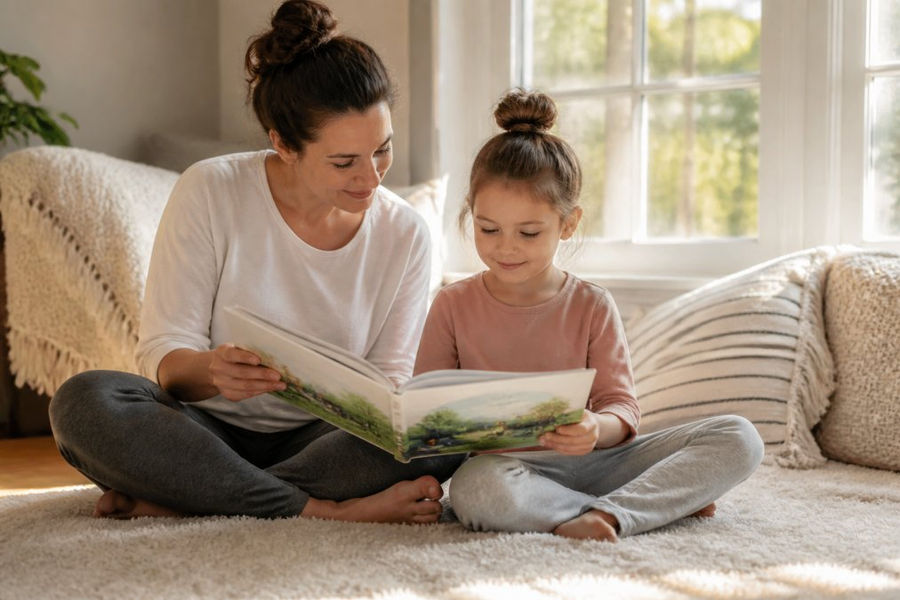
Try these after reading:
Belly breathing: hand on tummy, feel it rise and fall
Five senses grounding: name five things you can see, four you can hear
Squeeze and release: tense fists, then let go
Color hunt: find three blue things in the room to reset focus
Story breathing: breathe in for the count of the character's steps
How to Teach Meditation to Children Using Books
Learning how to teach meditation to children starts with modeling, not explaining. Kids copy what they see. If you sit down and breathe, they will too.
The Five Rules That Make It Work
Pick a calm time, not mid-tantrum
Read the book together at the same time each day
Do the breathing move yourself, out loud
Name the feeling when it shows up
Practice when your child is already calm
Pro Tip Practice the technique when your child is calm, not upset. A brain in fight-or-flight can't learn a new skill. Teach it during happy moments so it's ready when anxiety hits.
Step-by-Step: Introducing Meditation at Home
Follow this sequence over about two weeks:
Days 1-3: Read the book at bedtime, no pressure to participate
Days 4-7: Add one breathing move after reading
Days 8-11: Ask your child to lead the move
Days 12-14: Use the move during a mildly stressful moment
Expect it to feel awkward at first. That's normal.
Parent Scripts: What to Actually Say
These are the moments that decide whether the book becomes a habit or a one-time read.
Discussion Questions to Use With Any Calming Book
After reading, pick one, not all four:
"What did the character do when their body felt wiggly?"
"Can you show me the breathing move from the story?"
"When could we use this at school?"
"What color would your calm feel like?"
Open-ended questions keep the child talking. Yes-or-no questions end the conversation.
Troubleshooting: When It Isn't Sticking
Child refuses to participate: keep reading the book anyway. Exposure without pressure builds familiarity, and most kids join within a week or two.
Child gets sillier instead of calmer: shorten the session and add movement first. Some kids need to discharge energy before they can settle.
It works at bedtime but nowhere else: practice the move in a neutral spot, the car, the kitchen floor, so the child doesn't associate it only with sleep.
You forget to do it: attach the practice to something you already do daily, like teeth brushing or the last story of the night.
Making the Technique Portable
A calming tool only helps if the child can use it away from home. Once the move is familiar, give it a short name, practice it in the car, and remind your child they can use it at school without anyone noticing. The goal is a tool the child owns, not a routine that only works when you're in the room.
Guided Meditation Scripts for Children: What Works Best
The strongest guided meditation scripts for children are short, sensory, and repetitive. They use the five senses and a slow, even pace. Long scripts lose young kids fast.
What works:
Under three minutes for ages 4 to 6
Second person: "You feel your breath go in"
Sensory words: warm, soft, slow, heavy
A clear ending so the child knows it's done
Budget-Friendly and Library-Accessible Options
You don't need a shelf of books to start. Many families find that one well-loved book used daily beats ten books used once.
Ways to keep costs down:
Check your local library for picture books on feelings and calm
Ask about interlibrary loan if your branch lacks a title
Look for library story-time programs that include mindfulness themes
Buy one core book and use it as your daily anchor
Watch Out Don't buy a stack of books at once. Too many choices overwhelm an anxious child. Start with one, wear it out, then add another.
Supporting Neurodivergent Kids and Classroom Use
Standard calming advice doesn't fit every child. Kids with ADHD, autism, or sensory processing differences often need more movement, more repetition, and clearer cues. This is the section most book lists skip entirely, they recommend the same five titles to every family and never separate anxiety that comes from overload from anxiety that comes from uncertainty.
Anxiety Driven by Overload (Common With ADHD and Sensory Processing Differences)
When a child's nervous system is already flooded by noise, transitions, or too many instructions, a quiet meditation book can add one more demand. The fix is to discharge energy first, then read.
What tends to work:
Heavy work before reading: wall pushes, carrying a laundry basket, or pushing a full book bin across the floor for 60 to 90 seconds
Movement built into the story: let the child sway, rock, or tap a foot while you read, stillness is not the goal
One instruction per page: if a spread asks for three things at once, simplify it out loud as you go
A visible finish line: "two more pages, then we're done" lowers the cost of starting
Anxiety Driven by Uncertainty (Common With Autism)
For many autistic kids, anxiety comes from not knowing what happens next, a substitute teacher, a change in routine, an ambiguous social moment. A meditation book helps most when it makes the invisible visible.
What tends to work:
Predictable structure: the same opening line, the same closing line, every single time
Literal language: "your tummy goes up and down" lands better than "imagine your breath is a gentle wave"
Visual supports: pair the book with a simple picture card showing the breathing move, so the child can use it without the book
A named method: when the technique has a name, the child can request it, "I need the Woo-Woo", instead of having to describe a feeling
What to Avoid Across Both Profiles
Long scripts with no clear ending
Books that require the child to sit still and close their eyes on the first try
Introducing a new book during a hard moment, teach it while calm, use it while stressed
Stacking multiple new techniques in one week
Using the Same Book in a Classroom
Teachers can run one book across a whole class without singling anyone out. Read it during a calm-down corner break, after recess, or during a transition between subjects. The rhyme and repetition help kids with different attention spans stay with it, and because everyone hears the same story, no child is marked as the one who needs the calming book.
A practical sequence for a group:
Read the book once with no expectation of participation
Read it again the next day and do the breathing move yourself, out loud
On day three, invite the class to join, never require it
Keep a picture card of the move posted where kids can point to it
For neurodivergent kids, the goal is not a quiet child. The goal is a child who has one reliable tool they can name, request, and use without help. Movement, repetition, and clear endings get you there faster than silence.
Conclusion
Anxious kids don't need more information. They need one simple, repeatable tool they trust.
Frequently Asked Questions
What is the 3-3-3 rule for anxiety in children?
The 3-3-3 rule is a grounding technique that asks a child to name three things they can see, three sounds they can hear, and three body parts they can move. It helps interrupt a worry spiral by bringing attention back to the present moment. Many meditation books for anxious kids include similar grounding exercises. You can practice it alongside reading: pause after a calming page and ask your child to try it. This simple method builds self-regulation skills over time.
How can meditation books help children manage anxiety?
Meditation books give children a concrete, repeatable routine they can return to when worry hits. Stories with rhythmic language and calming illustrations slow breathing and lower arousal. When a book names a specific method, like a character who uses a 'Woo-Woo' to center themselves, kids gain a tool they can recall on their own. Reading together also creates a safe, predictable moment that reduces bedtime anxiety and builds emotional vocabulary.
What should I look for in a mindfulness book for my child?
Look for age-appropriate language, engaging rhymes or repetition, and illustrations that convey calm rather than stimulation. Check whether the book teaches a named technique your child can practice independently. Interactive elements, like breathing prompts or visualization cues, add value. For anxious kids, choose stories where the character faces a relatable worry and resolves it. Books that include parental guidance or discussion questions help you extend the practice beyond the page.
How do I introduce meditation to an anxious child?
Start short: two to three minutes is enough for young children. Pick a consistent time, like bedtime, and read a meditation book together in a quiet space. Model the breathing yourself so your child can mirror you. Use guided meditation scripts for children that include simple visualizations, such as imagining a warm light or a safe place. Avoid forcing stillness; let your child fidget if needed. Praise effort, not perfection, and repeat the routine nightly to build comfort.
Order Now!


Comments